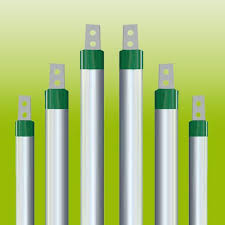
CPRI tested and certified copper bonded rod earth electrodes are made of low-carbon steel of superior grade and quality, with a high tensile strength of at
least 600N/mm2. 250 microns of copper is molecularly bonded to nickel sealed steel rods to avoid copper to steel merging. This provides ensured performance and double
protection as required under UL 467 and IEEE spec which by our in-house testing making sure that our copper bonded rods are excellent in corrosive soil.
Electrode Bending Test Process
TEST PROCEDURES: A length of the rod shall be rigidly held in a clamp or vice. Applied a force normal to the free end of the rods at a distance from the clamping
device equal to 40 times the rod diameter. The application of the force shall be such that the rod is permanently bent through 0 30-degree angle.
RESULT: There was no cracking of the coating when subjected to the test described above. These different samples were subjected to the above test.
Thickness of Protective Coating Test
PROCEDURES: The thickness of the protective coating shall be determined by a reliable magnetic coat tester, with the tester hold vertically on the specimen.
RESULT: The copper coating thickness was measured as 0.25mm or 250 microns at all the points of the rod. Three different samples were subjected to the above tests.
In addition to the above tests, CPRI, Bangalore have conducted short time withstand current tests on two different sizes of copper bonded rods. No cracking or
breaking or melting of the rod was noticed after the test. The copper cladding was intact.
Adherence of Coating Test Process
TEST PROCEDURE: A 467mm (18”) length of rod with one end cut to a 45 degree shall be driven between two steel clamping plates or the jaws of a
vice set 1.02mm (0.04 inch) less than the diameter of the rod, so as to shear off sufficient metal to expose the bond between the coating and rod.
RESULT: There was no separation of the coating from the steel core when subjected to the test described above. Three different samples were subjected to the above test.
- Used 100% copper for long life.
- Designed for fast fault current dissipation.
- Low maintenance on site.
- Easy & fast installation.
- Meets requirement of IS/IEC/IEEE Standards.
- Maintenance Free grounding.
- Provides positive low resistance electrical connection to the earth.
- Backfill compound Resistivity range starting from 0.12 ohm mtr.
- Gives flexibility in adopting any grounding system design.
- Suitable for any kind of Soil.
- Will not leech or diffuse into the ground.
- Easy to install.
- Environmentally friendly-No hazardous chemical.
- Offers a stable grounding system.
- Contains a corrosion inhibitor to protect copper.
- Compatible with plate, Rod, Strip electrodes.
- Comprehensive solution as per national and international standards IS-3043, BS-7430 & IEEE-80, IEC 62561-7 (For backfill compound), and IEC-60364-5 for a permanent solution to lower earth resistance.
| Material |
Copper Bonded MS |
| Rod length (l1 ) |
1000mm | 2000mm | 3000mm |
| Diameter Ø (d1 ) |
14mm | 16mm | 17.2mm | 20mm | 25mm | 32mm |
| Hole Diameter Ø |
8mm | 10mm | 12mm |
| Hot-dip galvanisation - single value: |
≥100µm |
| Hot-dip galvanisation - average value: |
≤254µm |
| Tensile strength |
≤ 32,000 psi |
| Static tensile strength (vertical tension) |
approx. 22000 N |
| Specific conductivity |
≥ 6.66 m/Ohm mm2 |
| Specific resistance |
≤ 0.15 Ohm mm2 / m |
| Short-circuit current (50 Hz) (1 s; ≤ 300 °C ) |
≤ 20kA |
| Impact Resistance |
20K |
| Standard |
EN 62561-2 |
- Petrochemical, CNG, and Nuclear Facilities
- Data Centre, Telecom and Broadcasters
- Process control and automation
- Government, Military, and defence
- Substation, Wind turbines
- Lightning Protection Systems
- Substation
- Data Centre
- CNC Machine
- Telecom Industries
- UPS. EPBAX, FAX etc
- Railway Signalling